Alien Shape
In keeping with the family name diversidae, alien shapes are very diverse. The alien description system is wild and unpredictable. An alien shape is a mash-up of body parts from a list of mundane terra denizens. Each body part listed should be familiar to the reader. Four different body parts are combined to create a new alien shape. The four body parts are proportional to each other and represent appearance only. The size category or the alien determines its size, not its body parts. For example, an alien with a wate of 10kg and a tiger torso would have a proportionally scaled-down tiger torso.
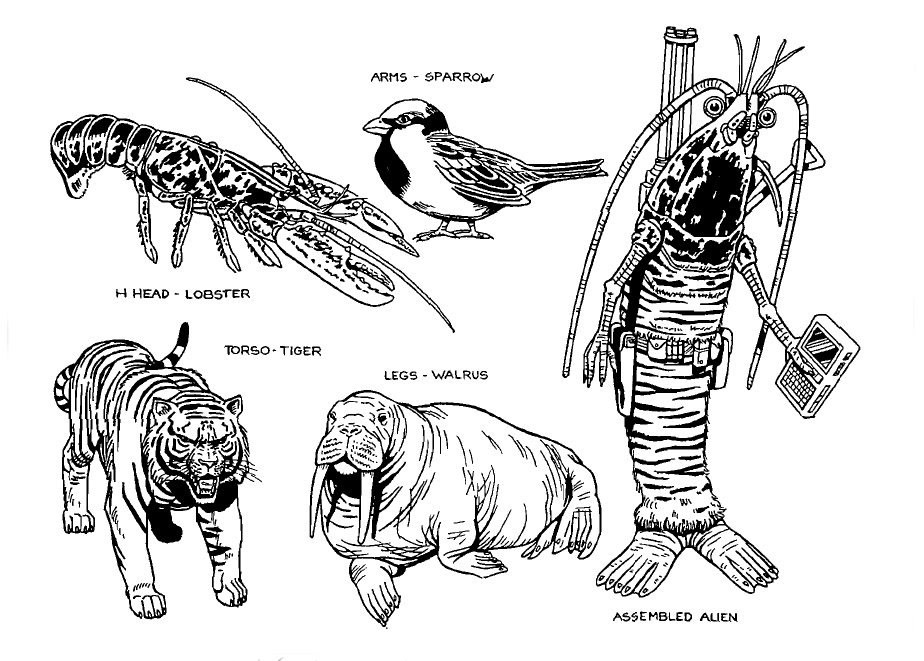
Four rolls. One alien.
Don’t let scientific knowledge get in the way of fun and storytelling. The alien is not a 542 kg pink amoeba. The alien has a wate of 542 kg, and it looks like an amoeba.
Shape Determination
The player generates a head, torso, arms and legs. Each body part represents the shape a creature from mundane terra. The body part does NOT bestow any special abilities onto the alien. For example, a scorpion torso would not be poisonous. The body part may not even have the same colour or coat texture of the animal type. The body parts’ mash-up determines the alien’s shape and her movement rate.

Head: t-rex, Torso: triceratops, Arms: lynx, Legs: manta ray
Head
The alien’s head part usually stores the alien’s brain and sensors. The head is usually located at the front of the alien. Record the terrain data (l, a, w, s) associated with the head part.
Torso
The alien’s torso part usually stores the alien’s vital organs. The part does not indicate the types of vital organs, but they are most likely in the torso. Record the terrain data (l, a, w, s) associated with the torso part.
Arms
The alien’s arms part usually indicates the alien’s front limbs and articulators. The arms part does not affect whether the alien is a tool user or not. Record the terrain data (l, a, w, s) associated with the arms part.\
The arms part has no bearing on whether the alien is a tool user or not. The society elements determine tool use, not the alien’s shape. An alien with opposable thumbs may not recognize a tool at all. An alien with no obvious tool using appendages will still be a tool user. The alien will have adapted the tools to match their flippers, hooves or fins.
Legs
The legs part usually indicates the primary way the alien moves. Record the terrain data (l, a, w, s) associated with the legs part.
The legs body part does not solely determine alien locomotion. If an alien can fly and run, it will have the parts for both. If the alien has parrot arms and fish legs, it may fly and slither.
Terrain Data
You will immediately notice that each body part is followed by some letters in parentheses. This data is used later to determine the movement rate of the alien. It is recommended to record this info along with the body part. Keeping track of the terrain types letters (l, a, w, s) helps determine Alien Movement later.
| Roll 1d100 and 1d6 for Head, Torso, Arms, and Legs. | |||
|---|---|---|---|
Roll |
(1d6) |
||
(1d100) |
1-2 |
3-4 |
5-6 |
01-02 |
Alligator (lw) |
Gorilla (l) |
Platypus (lw) |
03-04 |
Amoeba (w) |
Grasshopper (la) |
Porcupine (l) |
05-06 |
Amphioxus (s-w) |
Guinea pig (l) |
Preying Mantis (l) |
07-08 |
Anemone (s-w) |
Hammerhead (w) |
Priapulid (w) |
09-10 |
Ant (l) |
Hawk (a) |
Pterosaur (a) |
11-12 |
Anteater (l) |
Hectapus (w) |
Puffer fish (w) |
13-14 |
Antelope (l) |
Hippopotamus (lw) |
Rabbit (l) |
15-16 |
Ape (l) |
Horse (l) |
Rat (l) |
17-18 |
Armadillo (l) |
Horseshoe Crab (lw) |
Raven (a) |
19-20 |
Barnacle (s-w) |
Jellyfish (w) |
Rhinoceros (l) |
21-22 |
Bat (a) |
Kangaroo (l) |
Scorpion (l) |
23-24 |
Bear (l) |
Kelp (aw) |
Sea Star (s-w) |
25-26 |
Beaver (lw) |
Koala (l) |
Sea Spider (w) |
27-28 |
Beetle (la) |
Ladybug (la) |
Sea Urchin (s-w) |
29-30 |
Blimp (s-a) |
Lamprey (w) |
Seagull (law) |
31-32 |
Blue Whale (w) |
Lemur (l) |
Seahorse (w) |
33-34 |
Brontosaur (l) |
Leopard (l) |
Seal (lw) |
35-36 |
Budgie (a) |
Lion (l) |
Shark (w) |
37-38 |
Butterfly (a) |
Lizard (l) |
Sheep (l) |
39-40 |
Cactus (s-l) |
Lobster (w) |
Shrimp (w) |
41-42 |
Camel (l) |
Lynx (l) |
Skunk (l) |
43-44 |
Capybara (lw) |
Mammoth (l) |
Sloth (l) |
45-46 |
Cat (l) |
Manta Ray (w) |
Slug (l) |
47-48 |
Caterpillar (l) |
Marmot (l) |
Snail (l) |
49-50 |
Centipede (l) |
Mite (l) |
Snake (l) |
51-52 |
Chimpanzee (l) |
Mockingbird (a) |
Sperm Whale (w) |
53-54 |
Cicada (la) |
Mole (l) |
Spider (l) |
55-56 |
Clam (w) |
Moose (l) |
Sponge (s-w) |
57-58 |
Cockroach (l) |
Morel (s-w) |
Squid (w) |
59-60 |
Conifer (s-l) |
Mosquito (a) |
Stegosaurus (l) |
61-62 |
Coral (s-w) |
Moth (a) |
Swan (law) |
63-64 |
Cow (l) |
Mouse (l) |
Tarantula (l) |
65-66 |
Crab (lw) |
Mule (l) |
Tarsier (l) |
67-68 |
Crocodile (lw) |
Mushroom (s-l) |
Tasmanian Devil (l) |
69-70 |
Dog (l) |
Nototherium (l) |
Termite (l) |
71-72 |
Dolphin (w) |
Opossum (l) |
Tick (l) |
73-74 |
Do do Bird (la) |
Orangutan (l) |
Tiger (l) |
75-76 |
Dragon (law) |
Orca (w) |
Triceratops (l) |
77-78 |
Dragonfly (a) |
Osprey (a) |
Trilobite (w) |
79-80 |
Duck (law) |
Ostrich (l) |
Turtle (lw) |
81-82 |
Elephant (l) |
Ox (l) |
Tyrannosaurus (l) |
83-84 |
Fern (s-l) |
Oyster (w) |
Viper (w) |
85-86 |
Ferret (l) |
Paramecium (w) |
Vole (l) |
87-88 |
Fly (a) |
Penguin (lw) |
Vulture (a) |
89-90 |
Frog (lw) |
Piranha (w) |
Walrus (lw) |
91-92 |
Gila Monster (l) |
Pig (l) |
Wasp (a) |
93-94 |
Giraffe (l) |
Pill bug (l) |
Wolverine (l) |
95-96 |
Goat (l) |
Planaria (w) |
Wombat (l) |
97-98 |
Goose (law) |
Plasmodium (w) |
Worm (l) |
99-00 |
None (s) |
None (s) |
Ref’s Own Table |
(1d100) |
1-2 |
3-4 |
5-6 |
Roll |
(1d6) |
||
Roll 1d100 and 1d6 for Head, Torso, Arms, and Legs. |
|||
Record letters in brackets l=land, a=air, w=water, s=sessile. |
|||
Proportions
Each body part is proportional to the other body parts in the description. The alien’s size attribute (Small, Medium, Large, etc.) determines the alien size, not her body parts. A mosquito head part combined with a bear torso part would have matching sizes. The alien would not have a microscopic head on a bear torso. The alien looks like a bulky hairy body with an insectoid head sporting a long proboscis. The mosquito’s head would be a size proportional to the bear’s torso.
The corollary is true. The alien’s size attribute (Small, Medium, Large, etc.) determines the alien size, not her body parts. A giraffe head part combined with a sperm whale torso part would still be tiny. The alien looks like a square blubbery body with a giraffe head on a long neck. The whole abomination is about the size of a german shepherd.
Missing Parts
If the player rolls None for a body part, that part is not there. The alien does not have any use for that particular body part. An alien with no head part may have sensors attached to the torso. An alien with no legs may move by utilizing the torso or be immobile. Missing parts decrease the alien’s movement rate. An alien with no body parts would be a gaseous or blob entity.
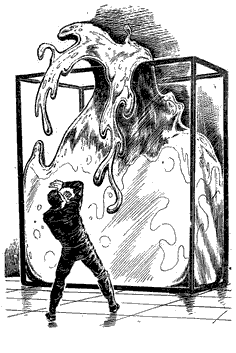
No parts. No body.
Adornments
These are optional accents to the alien’s appearance. Adornments are entirely descriptive. Adornments do not detract from or add any abilities to the alien. The player chooses the details (amount and size) of the adornments.
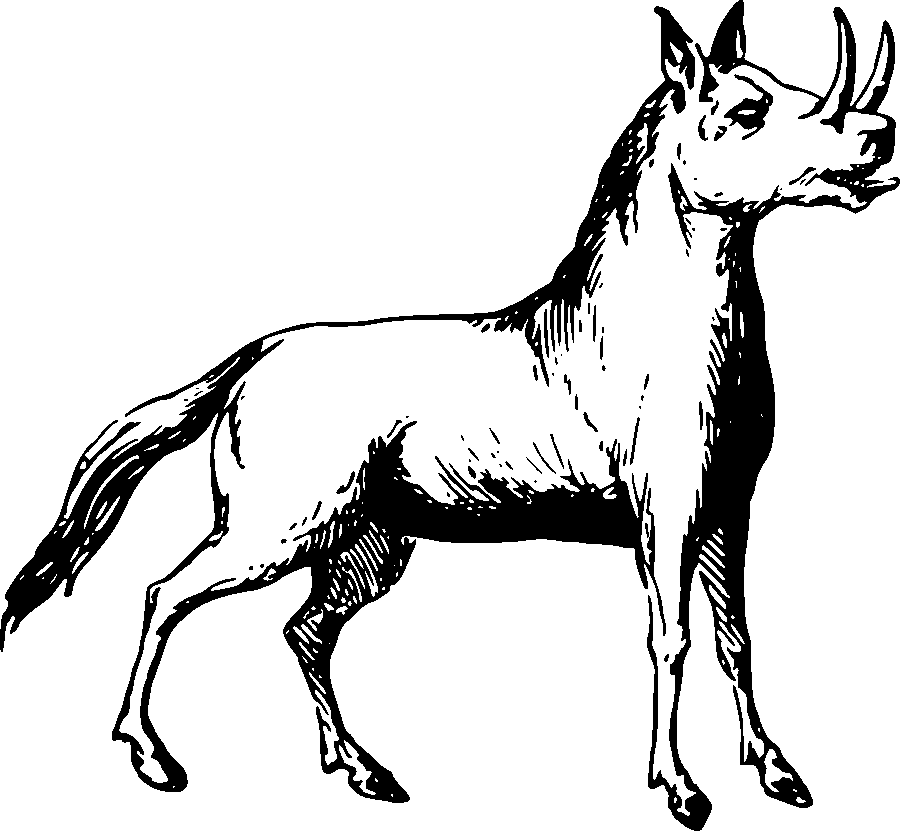
Head tusklers.
| An accent for the head if desired. | |
|---|---|
Roll 1d12 |
Head Adornment |
1 |
Antenna(e) |
2 |
Antler(s) |
3 |
Ears (any) |
4 |
Horn(s) |
5 |
Knob(s) |
6 |
Peak(s) |
7 |
Plume(s) |
8 |
Quill(s) |
9 |
Spines(s) |
10 |
Tufts(s) |
11 |
None |
12 |
Ref’s Own Table |
Roll 1d12 |
Head Adornment |
| Replacement for grabby things, if desired. | |
|---|---|
Roll 1d10 |
Arms Adornment |
1 |
Adhesive |
2 |
Claws |
3 |
Hands (any) |
4 |
Hooves |
5 |
Magnetic |
6 |
Paws |
7 |
Pincers |
8 |
Talons |
9 |
Tentacles |
10 |
Ref’s Own Table |
Roll 1d10 |
Arms Adornment |
| An accent for the torso if desired. | |
|---|---|
Roll 1d20 |
Body Adornment |
1 |
Arms Adornment |
2 |
Bump(s) |
3 |
Crest(s) |
4 |
Head Adornment |
5 |
Hole(s) |
6 |
Knob(s) |
7 |
Knurl(s) |
8 |
Lumps (wet) |
9 |
Lumps (dry) |
10 |
Ridge(s) |
11 |
Ruff(s) |
12 |
Scales |
13 |
Slime |
14 |
Spine(s) |
15 |
Spout(s) |
16 |
Tree(s) small |
17 |
Vine(s) |
18 |
Wing(s) |
19 |
None |
20 |
Ref’s Own Table |
Roll 1d20 |
Body Adornment |
Coat and Colour
The alien will usually have a unified coat chosen from one of the four body parts generated. This is chosen by the persona. For example, if one of the body parts is budgie, the entire alien could be covered in feathers. Even the ape arms of the alien would be covered in feathers. The alien does not appear as a patch work of different hides.
The alien will usually have a unified colour chosen by the persona or generated at Persona Cues Colour.