Introduction
Questions partially answered.
EXP: The Game of Technological Chaos is a paper and dice Sciency Fiction role-playing game. It is not a POV shooter video game, movie, or app. You play EXP with dice and real people all sitting in the same room.
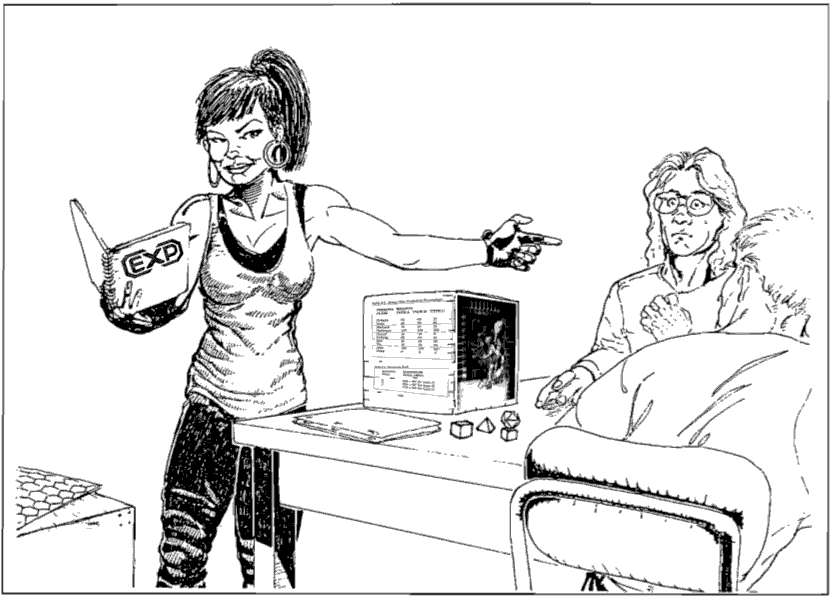
Do you get my point?
At this point most tabletop role-playing games will take the opportunity to wax philosophic about life, the universe and everything. We assume you have not randomly arrived here and do not require a lengthy orientation. In short, this web site is the rule set for a role-playing game in the vein of Dungeons and Dragons. This flavour of role-playing game is Sciency Fiction.
You play the game using the document you are reading now. Usually one player, called the referee, will peruse this content and make up a story for their friends to partake in. All these folks get together in real life and play EXP as a tabletop role-playing game. If you are familiar with role-playing games but new to EXP, you can probably skip this chapter.
Newbies
The old version of this section was replete with ideas on how to find other players or form play groups. Role-playing games are now omnipresent. Nowadays you can find game groups online, in game stores, libraries and churches everywhere. It remains tricky to find like-minded folks playing the games you want to play. However, a detailed “how to get started in RPGs” lecture is outdated.
Concerned Parents
In the 1990s, every role-playing game had a section that tried to calm concerned parents. A bored media created a moral panic around role-playing games, and police forces raided game producers. Role-playing games improve numeracy, literacy, creativity and social skills. Today parents are concerned if their children are not playing role-playing games. Today a concerned parent is playing role-playing games with the family, not banning them.
Why create EXP?
In the 1970s, designers were still inventing role-playing games, and the board game culture was 50 years away. Science fiction was a non-existent part of the tiny world of role-playing. There was a game called Dungeons and Dragons, which was a collection of tiny incomplete booklets. Traveller was also a disorganized collection of tiny booklets. We were fans of post-apocalyptic speculative fiction, especially anything with mutants and robots. The author James Ward came to our rescue with Metamorphosis Alpha and Gamma World. To be clear, James Ward is our hero.
We loved the concepts but not the rules. Our table used miniatures and hex paper to sort out combat. War games still had an enormous influence on how designers developed role-playing games. Combat resolution was tactical, detailed, and obsessive.
A twenty-sided die was not refined enough for us. We devised a thousand-sided die by rolling three ten-sided dice together. The 1 to 1000 range allowed us to give subtle bonuses or penalties on the hexagonal mat. EXP mashed Metamorphosis Alpha, Gamma World and tactical miniature combat into one book.
The single largest driving force for the creation of the original EXP book was cost. Around the 1980s the players around our table were finding the total book cost required to play was getting too high. This antiquated concept seems quite laughable in the face of today’s cost of ownership to play any major title.
What’s In A Name?
The working title of the homebrew (1980) was EXP 1000. This cumbersome title was a reference to the 1000-sided die roll and its experimental nature. Folks just started calling it EXP.
Those three letters kept coming up in other ways. The teams of players called themselves expeditions, not parties. Personas gained levels by collecting experience points. Since we had eschewed the canonical 20-sided dice, we felt experimental. EXP also had a rhythm similar to a famous 3-letter role-playing game around the same era. Of course, there were always a few folks who pronounced it “ecks pah.”